Monday, October 15, 2012

Your Book Promotes You!


By: Zoe Ghahremani

People ask me, “How did you promote your book?” Which is often a polite way to say, “How did the first English novel of an unknown writer with an unpronounceable name make it this far?” They are not alone as I continue to ask myself the same question. I’ve thought about this for some time and think I may have found the answer.

What most writers underestimate is the readers’ power. We think we know what they need to read. But readers are on to us as they see right through what is written for “the market.” Such writing may see a fleeting success, but it will not last long on the shelf. You can try to sell what you think will sell, but in this day of bad economy and little time, people are more selective about what they read. Also, weary of false advertisements and book pushers, most people seek advise from friends or their friendly bookstore. And thanks to the Internet, satisfied readers can broadcast their finds to the entire world.

Writers are readers first. We read more than anyone in any other profession. I try to read a book a week – though I don’t always succeed – and know of colleagues who read even more. So I write what I can imagine spending money and time on. It’s important to sit back, wipe all other ideas from your mind and read your manuscript as a book you imagine you just bought. Does the content hook you? Do you have a hard time putting it down? Does it present a fresh voice? The questions are many and you’ll need to answer them with honesty. Don’t forget, you’re now a reader and not the writer in need of positive feedback!

San Diego is a literary rich city. Most people may not know it, but there are hundreds of writers, poets, and capable editors right here. We also enjoy multiple literary organizations and benefit from each other’s support. I have been a fortunate member of a few and served on the board of two major ones. In addition, having attended over 120 local book clubs this year alone, I am overwhelmed by the number of readers and the high level of public interest in books. But the amazing fact is that I did not find my readers, they found me!

Here I was, a writer living in my little computer cave, typing away. It was the reader who found my book and brought it to the table when a committee gathered to nominate a book for the city to read. And in the end, it was the readers who voted for it. In fact, I later learned that not just one, but that two other committee members had also presented my book on that fateful day! I still have no idea who the committee members are. Yes, I had the pleasure of meeting a couple of them after the selection of my book, but know nothing about the other members and/or the details of the selection process.

The year has been a fantastic journey to Cloud Nine, but as my tennis coach used to say, “You’re only as good as your next shot!” While I prepare for the imminent publication of my next novel – The Moon Daughter – I ask myself three major questions. “Is this book as strong as my last one, or am I letting down my readers?” Then I wonder, “Would I enjoy reading this book if I wasn’t the writer?” and, “Would I pay $15.00 to purchase it?” Readers have set the bar so high that I must answer these important questions with utmost honesty.

Last year, as I prepared to send the manuscript to print, I realized my answer to the first question was not entirely positive. I recalled the many times that an author’s second book had not met my expectation. I didn’t want to be such an author. So I took the manuscript out of its box and worked at it another entire year. Now with three strong ‘yes’s, I proceed with its publication and hope to have it out soon. How soon? Only after I see that the galley looks perfect and that it is absolutely worthy of the readers who deserve nothing but the best. Will San Diegans enjoy The Moon Daughter? I don’t have the answer. My novel does.

Tuesday, September 11, 2012

San Diego Writing Women 
Book Fair Party

WHEN: Saturday, October 13 from 5 to 9 p.m.
WHERE: Seaside Home,1055 Wall Street (the former Saks Fifth Avenue store) in La Jolla, CA
TO RSVP: Please contact Caitlin Rother, at crother@flash.net, by October 6

Please join us for a night of readings from our members’ newest and locally honored books as well as a stimulating interactive discussion about why and how we write. Guests will have a chance to chat with individual authors while enjoying complimentary fine wine, hors d'oeuvres and live music at this beautiful venue, a home furnishings and interior design store in La Jolla.

The readings will include this year’s Geisel Award winner FINDING EMILIE by Laurel Corona, the controversial LOST GIRLS by Caitlin Rother, the critically acclaimed THE CARE AND HANDLING OF ROSES WITH THORNS by Margaret Dilloway, and SKY OF RED POPPIES, this year’s One Book, One San Diego winner, by Zohreh Ghahremani. (See Books page on this blog for more details.) Authors Kathi Diamant, Georgeanne Irvine, Marjorie Hart and Divina Infusino also will be doing readings.

“Last year, we launched the group to celebrate the written word, and announce our goal to share our combined knowledge and experience with readers, writers and aspiring writers everywhere,” said Rother, the group's founder and spokeswoman. “With this event, we want to continue that literary conversation as we introduce our new books and new members to our growing writing community.”

Featured Authors and program schedule:

Doors open at 5 p.m.: Meet the authors, have some wine and hors d'oeuvres, listen to some music and check out the authors' books, which will be available for purchase and which they will sign for you.

5:30 to 6:05 p.m.: Opening remarks by Caitlin Rother and the first set of readings:

Laurel Corona is a historical novelist and professor of Humanities at San Diego City College. In addition to 17 Young Adult nonfiction titles and the Christopher Medal non-fiction winner UNTIL OUR LAST BREATH, Laurel has written four novels, including two Theodor S. Geisel Award winners (Best Book of the Year by the San Diego Book Awards, SDBAA), THE FOUR SEASONS and FINDING EMILIE. Her latest novel, currently being marketed, focuses on Spanish Jews before the 1492 expulsion by Ferdinand and Isabella. She is a board member of San Diego Writers Ink and of the Friends of the New Central Library. www.laurelcorona.com

Margaret Dilloway is the author of the critically acclaimed novels, THE CARE AND HANDLING OF ROSES WITH THORNS, and HOW TO BE AN AMERICAN HOUSEWIFE, both published by Putnam Books. Entertainment Weekly called ROSES “an exquisite little novel,” and Library Journal said it’s “a captivating study of how love and understanding nurture our lives.” HOUSEWIFE got four out of four stars from People magazine, and was a finalist for the John Gardner Fiction Award. A graduate of Patrick Henry High and Scripps College, Margaret lives in San Diego with her husband, a former Army Ranger, and their three children. http://margaretdilloway.com

Kathi Diamant is an author, actor and broadcaster, who has devoted decades to uncovering a literary mystery. Since 1990, Kathi has followed in the footsteps of literary giant Franz Kafka and his last love, Dora Diamant (no known relation) to discover a world-class love story, set against the most dramatic points in the 20th century. Her literary detective work resulted in an acclaimed biography, KAFKA'S LAST LOVE: THE MYSTERY OF DORA DIAMANT, which won the SDBAA’s Geisel Award for Best Book of the Year. Her book has been translated into French, Spanish, Russian, Chinese, Portuguese and, in 2013, into German.      

San Diego native Georgeanne Irvine has devoted more than three decades of her career to raising awareness about animals and wildlife conservation.  By day, she is associate director of development communications for the San Diego Zoo, where she has worked for 34 years. George is also the author of more than 20 children’s books plus numerous magazine, newspaper, and Web articles. George’s most recent work is the coffee table book, THE KATRINA DOLPHINS: ONE-WAY TICKET TO PARADISE, which is a true story about eight dolphins from an oceanarium who were washed out to sea during Hurricane Katrina and dramatically rescued.


New York Times bestselling author Marjorie Hart is the author of SUMMER AT TIFFANY, a memoir about arriving in New York City in 1945 with her college roommate and miraculously finding a job at Tiffany & Co.  An audio version of her book has been released, and this summer, through an arrangement with Harper Collins, it was translated and published by Newton Compton in Italy, under a new title, I LOVE TIFFANYThis July it became an international bestseller. In her past lives, Marjorie was a professional cellist and the chairwoman of the Fine Arts Department at USD. http://marjoriehart.com


6:05 to 6:30 p.m.: Music, munchies and musings. Chat with the authors, check out their books. 


6:30 to 7:30 p.m.: Kathi Diamant will lead an interactive group discussion about how and why we write, featuring Laurel Corona, Caitlin Rother, Margaret Dilloway, Zohreh Ghahremani, and Georgeanne Irvine


7:30 to 8 p.m.: Please stay for more music, munchies and musings and the second round of readings. In the meantime, chat with some more authors, check out some other books.
  

8 to 8:20 p.m.: Second set of readings:

New York Times bestselling author Caitlin Rother has written or co-authored eight books, including the controversial LOST GIRLS, the story behind the rape and murder of Chelsea King and Amber Dubois by sexual predator John Gardner. Caitlin, a Pulitzer-nominated investigative journalist, is also the author of POISONED LOVE, a SDBAA finalist. She teaches writing at UCSD Extension, and also works as a consulting TV producer and crime expert, research and editorial consultant, and public speaker. Caitlin’s pieces also have been published in the Los Angeles Times, Chicago Tribune, Boston Globe as well as The Daily Beast and The Huffington Post. http://caitlinrother.com

Zohreh “Zoe” Ghahremani is a freelance writer and a columnist for Zan magazine. Following decades of juggling a career in dentistry and writing on the side, she decided to follow her dream and become a full-time writer. More than a hundred of her articles have appeared in national magazines. She has written four books, including SKY OF RED POPPIES, a finalist in the SDBAA and the One Book, One San Diego winner for 2012. Zohreh has served on the board of San Diego Writers Ink and the SDBAA, and is a member of the Iranian-American Writer’s Association. www.zoeghahremani.com

Divina Infusino is the author of DAY TRIPS FROM ORANGE COUNTY: GETAWAY IDEAS FOR THE LOCAL TRAVELER, the writer of ROCK GODS, a rock ‘n’ roll photography collection, and a co-author of THE LOVE RESPONSE, a mind-body wellness book.  She is currently writing a new book, MYTHOLOGICAL HEROINES. An award-winning journalist, she worked as an entertainment staff writer and critic for The San Diego Union, as a staff rock critic for The Milwaukee Journal, a cultural commentator on KPBS, and a contributor to Rolling Stone, The Economist, TV Guide, Salon.com, The Huffington Post, Haute Living and other publications.


8:20 to 9 p.m.: Final chance to chat with the authors and check out their books. Music will last until 9 o'clock.  


ALSO FEATURING live music by Studio 2656, a group of veteran San Diego studio musicians:
Geza Keller of Fakebook (www.facebook.com/pages/FakeBook/199856955653), Joe Rosignolo and Jack Nathan, who will play a selection of songs from yesterday and beyond.


Authors will have books available to sell and sign. Cash and checks only please. We have no way to process credit card transactions for books. There are numerous affordable parking lots nearby in the village if you can’t find street parking.

Please contact group spokeswoman Caitlin Rother at crother@flash.net with questions or media inquiries or to book any combination of SDWW authors for an event with your group.

Many thanks to Seaside Home, which will be open during this special event, for generously hosting us. Check out the offerings here: http://www.seasidehomelajolla.com/index.html

Saturday, September 8, 2012

On the Road with Annie Nakamura


Part V of a series

In four previous blogs (October 2011, January 2012, April 2012, June 2012), I told the tale of Annie Nakamura’s request to be taken on one final road trip and to be buried in one of two locations--either on Hurricane Ridge, Olympic National Forest in Washington or at Anza Borrego Desert. Those blogs took the reader on a long journey as first four (Ann Kawasaki, Don Kelly, Janet Masuko-Kagimoto, Judith Liu) and then, three intrepid travelers (Ann, Don, and Judith) took Annie on her final trip.

This blog will contain pictures of that journey.


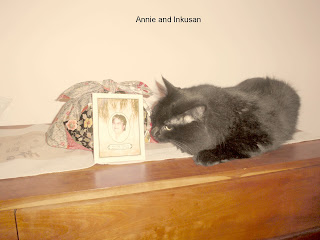
My cat, Inkusan, plays host to Annie while she was in our guest room.


One of Annie's favorite spots was Mono Lake.


Janet, Don, and Judith freezing atop Crater Lake on a "typical" "As you go Nakamura Tour" to Crater Lake--cold, rainy, overcast, and NO view of Crater Lake.


Cindy Andy, Chehalis Tribe, sweet grass basket with whale design holds Annie's ashes that was buried at Hurricane Ridge, Port Angeles, Washington.


Since that October 2011, whenever either Ann Kawasaki (aka Kawa) or I travel, Annie is along. In November 2011, Annie traveled to Ireland with Don and me; in July 2012, I took Annie to Beijing and several places in Yunnan province; August we went to Denver. While it may seem strange to bring ashes along wherever I go, Annie would have loved the idea.

Judith Liu

September 8, 2012


Saturday, August 18, 2012

My Footsteps on the Trail of ‘98: Part 2


By Georgeanne Irvine

My toes have now traipsed on the Trail of ’98 and my heart is filled with a gold mine of treasured memories from the experience!  I’m just back from a splendid trip to Alaska, where I was the guest enrichment lecturer on a Silverseas Cruise ship.  In my June 1 blog, I explained how the upcoming trip inspired my interest in the Alaska (Klondike) Gold Rush of 1898, especially because my grandfather, Pete, was a Klondiker.  He trekked the Chilkoot Trail in bone-chilling 40-below-zero temperatures, rescued other prospectors who were buried in the famous Chilkoot Pass avalanche, shot the perilous White Horse rapids, survived typhoid fever, and encountered the notorious con man, Soapy Smith.  This blog picks up where the other left off.

To Talk or Not to Talk About the Klondike

The day my three Klondike Gold Rush books arrived in the mail, I immediately read two and skimmed the third.  I continued my online research, downloaded more historical photos, restored the family photos of Pete’s adventures, and reviewed two additional Gold Rush books from my sister.  Even so, I hadn’t decided whether I should or would include a talk about Pete’s Gold Rush experience in my cruise ship lecture repertoire.  I had been asked to prepare four talks about critters and conservation because my expertise is animal stories.  In addition, the Alaska expert on the cruise would undoubtedly lecture about the Gold Rush.  Pete’s story was a personal, first-hand account of this dramatic moment in history, though, so I emailed the Silverseas enrichment program manager with my suggested non-animal topic.  Within seven minutes he responded, “What a wonderful idea! Nothing like personal experiences to get people’s attention.” 

Are Two Klondike Talks Better Than One?

In late July our ship, the Silver Shadow, set sail from Vancouver en route to several Alaskan ports including Skagway, a gateway city to the Gold Rush.  My three animal talks plus Blazing the Trail of 1898: My Grandfather’s Experience as an Alaska Gold Rush Klondiker were Powerpoint ready.  As I expected, the Alaska expert was featuring a talk about Gold Rush history.  I was OK with that because I knew my story was unique—until one of the staff said he was surprised that two lecturers were speaking on the same topic.  Gulp!  What should I do?  I had prepared several extra animal presentations.  Should I scrap my Klondike tale for Bentley the Tree Kangaroo’s Big Apple Adventure?  No…at least yet.

Instead, I took a break from studying my own presentations to listen the other Klondike talk.  I wanted to see how similar it was to mine.  Trail of the Argonauts: The Great Klondike Gold Rush was fascinating but very different!  What a relief!  A few of the photos overlapped but that was inconsequential because the two talks truly complemented each other.  The Alaska expert's historical perspective of the Gold Rush set the stage for Pete’s personal experience—and the passengers attended and loved both of our talks!  To my surprise, I received more compliments on my Klondike tale than any of my animal presentations.

The Grand Finale

My Alaskan adventure was filled with incredible wildlife sightings, from orcas and humpback whales to sea otters and spawning salmon.  We explored fjords, gazed at glorious glaciers, posed for pictures on the pontoon of our float plane after it landed on a glacial lake, and meandered through rain forests lush from the 150 inches of annual precipitation.  My most magical experience, however, was a misty morning on the Chilkoot Trail, sloshing through mud, slipping on rocks, and climbing steep hills, all in memory of Pete!  The guide was ecstatic because I was the first Klondiker descendent he had ever met.  He treated me like a celebrity plus he wanted to know every detail about Pete’s story on the Trail of ’98.

Although we hiked a mere 2.5 miles of the Chilkoot Trail’s 33 miles, just being in the area made me feel closer to Pete, who has been gone for 45 years.  (Note that the remaining part of his journey to gold country was another 550 miles.)  At the end of our hike we floated by raft down the Taiya River to what was once Dyea, the boom town from which my grandfather’s journey began.  I was amazed—and delighted—to find that Dyea has been reclaimed by nature.  It is now a wildlife-rich forest on the edge of an estuary, inhabited by black bears, bald eagles, porcupines, deer, and many more animals. 

I can never retrace or relive Pete’s extraordinary adventure but I can imagine and appreciate the hardships he endured as well as share his pioneering spirit through my Klondike talk, which now has an animal element after all.


San Diego native Georgeanne Irvine has devoted more than three decades of her career to raising awareness about animals and wildlife conservation. By day, she is associate director of development communications for the San Diego Zoo, where she has worked for 34 years. George is also the author of more than 20 children’s books, plus numerous magazine, newspaper, and Web articles. George’s most recent work is the coffee table book, The Katrina Dolphins: One-Way Ticket to Paradise, which is a true story about 8 dolphins from an oceanarium that were washed out to sea during Hurricane Katrina in 2005 and dramatically rescued a few weeks later.


Saturday, August 11, 2012

Fondling A Few August Nuggets

By Divina Infusino

Summer is one of the most inactive times in the publishing industry. A few major houses still practice the decades-old custom of taking off on Friday afternoons so they can beat the traffic to the Hamptons for the weekend. (Now that is a symptom of an old industry.)

The newer outlets for publishing are busier than ever, however. As I buzzed around this summer to publishing panels, I picked up a few bits and trinkets of information along the way.

Byliner.com and the Single

Byliner.com caused a stir when it published Jon Krakauer's Three Cups of Deceit. I took note of the book for three reasons:

It refuted the premise of the much talked about book on Middle Eastern culture, Three Cups of Tea;

Three Cups of Deceit sold more than 75,000 copies, which is a very good showing for such a book;

It came out as a "single."

A single, as Byliner.com's founder told us in a panel on e-publishing, is a work ranging between 5,000 and 30,000 words, that is meant to be read in one sitting. The form is perfect for e-publishing because something of that length can be read easily on an e-reader or a mobile device. Amazon, Apple and Nook all accommodate the single.

As a writer, all I could do was think "finally." I never really understood why publishing and most media did not accommodate this length of work. I presumed the reasons had something to do with printing and distributions costs. If so, e-publishing bypasses those concerns and can claim the single niche for itself.

Byliner.com acts like a traditional house in the sense it chooses which authors and titles the company will publish under its moniker. With Krakauer's success, Byliner. com has gone out and cherry-picked for its roster some of the best-selling names in books, including Elizabeth Gilbert (East, Pray, Love).
But what makes the single truly disruptive is that any business or entity can more readily act as a singles publisher.

Some of the major news organizations have jumped on the form. Why? Because e-publishing is fast. Byliner.com claimed that once it agrees on a book to publish, it can put it on sale in eight hours.

For a news operation, this is a bonanza. Greece threatens to default on its debt? A single on Greece's history on defaults and financial troubles--say 10,000 words or so-- could accompany a news article or broadcast on the current news event, providing some background. Michael Phelps leaves London with enough gold to set off a chorus of airport security alerts? A nice little 20,000  word single bio could satiate the public's immediate hunger to know more about the swimming hero.

But news organizations are accustomed to publishing. The single--not so long that it requires months of research and not so short that is appears inconsequential--has made it possible for a corporation, a non-profit, a cause or a political campaign to develop a publishing arm.

E-publishing has only begun to change not only the publishing landscape but the cultural one as well.

See below.

Vook and the Multi-media Book

Vook is an inexpensive technology that enables you to publish an e-book with photos, audio and video. This is truly multi-media publishing and for about $100, the technology for such a hybrid is available to most anyone.  And it is relatively easy, with drag and drop functions and simple uploads.

Vook could be a boon for children's books, business books, and any subject that cries for visuals as well as text. But I shuddered at the thought of what Vook would mean for fiction. (That is a subject for another blog).

If Vook is really that easy to use, looks good and works well, it could create a new form of publishing and new opportunities for writers. And if it is not all that it's cracked up to be, something else will take its place in the future. Once technology identifies a hole, it will fill it eventually.


50 Shades of Gray and the Library

The librarian got up in front of the audience to bash the short term life of digital rights. Apparently, major publishers grant digital rights to a library for a certain number of reads and when it is finished, the library must buy it again. Now, this was not your Marion the Librarian speaking. Her hair was dyed black and clipped irregularly, she wore layers of back lace and leather in some semblance of steam punk fashion and she had more make-up on than anyone else in the room. She was a hipster librarian--very smart and savvy.

Much of digital rights discussion rushed passed me. But my ears pricked up when she made an off-handed comment about the mommy-porn sensation--and perhaps the first real e-publishing phenomenon--50 Shades of Gray.  She said the book's popularity started in the libraries.

It did?

After the panel, I cornered her. What did she mean?

Her bright red lips slipped into a smile. She leaned in and whispered: "The library has an incredible collection of erotica. We just don't label it that way."

I walked away thinking that while publishing and distribution may change and even modify the content, some works are perennial no matter the form.

I also checked to make sure my library card was up-to-date.